
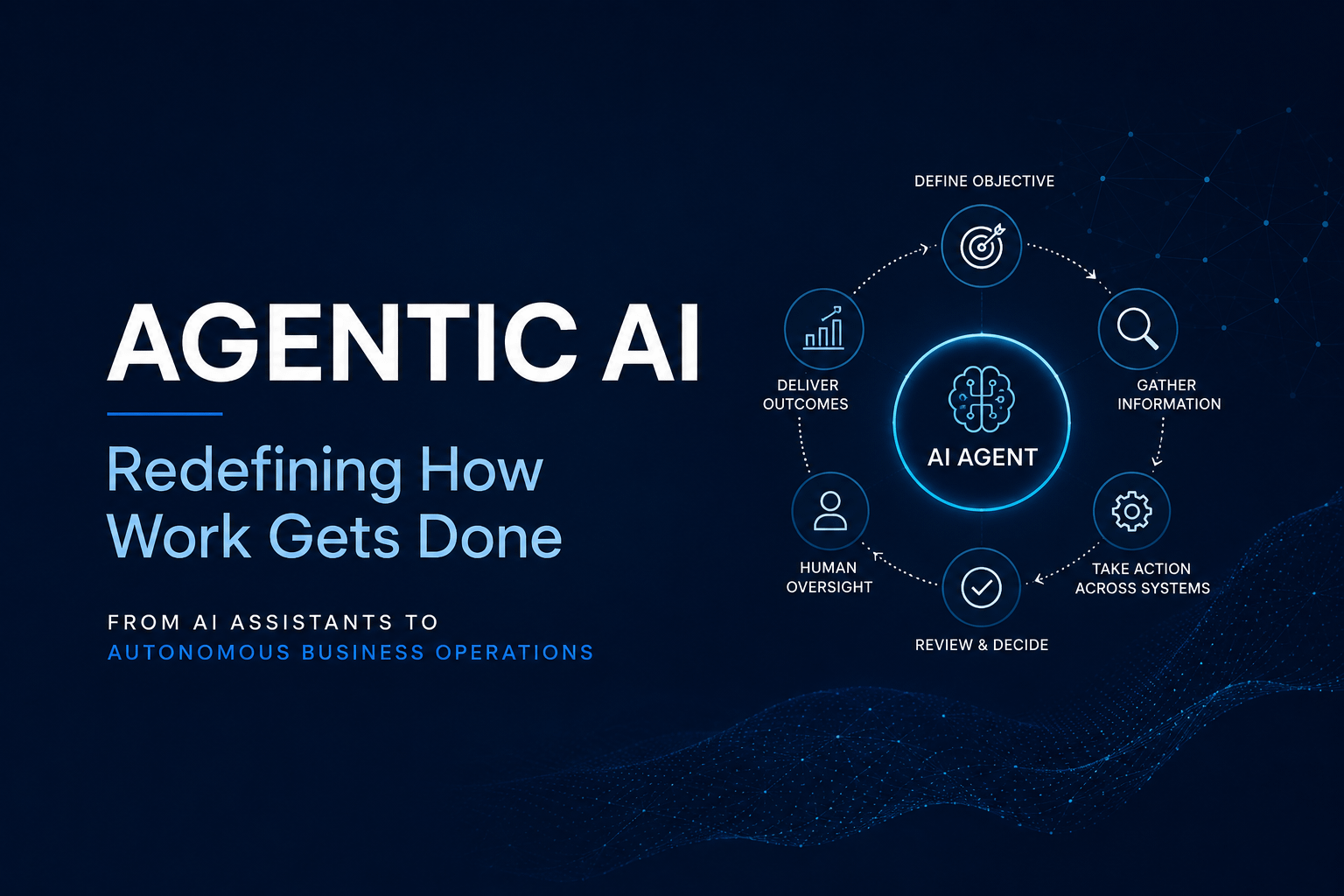
Executive Summary
Agentic AI is the next major evolution of enterprise AI. Unlike traditional generative AI, which responds to individual prompts, Agentic AI can plan, reason, make decisions and execute complete business workflows with minimal human intervention.
In this article, I explore:
- What Agentic AI actually is
- Why it represents a shift beyond chatbots and copilots
- Real business scenarios across sales, service, engineering and healthcare
- How teams of AI agents work together
- Enterprise governance considerations
- The leading Agentic AI platforms and where each one fits
- My predictions for where the technology is heading over the next five years
Whether you’re a CIO, CTO, product leader or business executive, understanding Agentic AI is likely to become increasingly important as organisations move from experimenting with AI to redesigning how work gets done.
For the past two years, AI has dominated boardroom conversations. Organisations have invested heavily in ChatGPT, Microsoft Copilot, Claude, Gemini and countless other tools. Employees are generating reports in minutes instead of hours. Developers are writing code faster than ever. Marketing teams are producing content at a pace that would have seemed impossible only a few years ago.
These are genuine productivity gains. Yet I believe many organisations are still looking at AI through the wrong lens.
Most discussions still begin with questions like “Which AI model should we use?”, “Should we standardise on Copilot or ChatGPT?” or “Can AI summarise documents?”. They’re reasonable questions, but they all assume AI is simply another productivity tool.
The more interesting question is this: what happens when AI stops helping people complete work and starts completing the work itself? That is where Agentic AI enters the picture.
I don’t think Agentic AI is simply the next buzzword. I think it represents the biggest shift in enterprise technology since cloud computing changed how organisations built and delivered software.
We’ve Been Thinking About AI as a Better Assistant
Most of today’s AI tools behave like exceptionally capable assistants. Ask them to draft an email, summarise a document, write code or analyse a spreadsheet, and the results can be genuinely impressive.
But once they’ve completed that individual task, they stop. The next step is still yours. You decide what happens next, who needs to be contacted, and whether the process should move forward.
Agentic AI changes that relationship. Instead of asking AI to perform one task, you give it an objective, and that objective becomes its focus until the work is complete. It sounds like a small difference. In reality, it changes almost everything.
Think About It This Way
Imagine you’ve just appointed a new project manager. On their first day, you don’t give instructions every five minutes. You explain the objective: deliver the project by September, stay within budget, manage the stakeholders, raise risks as they appear, and keep me informed. You trust them to work out what needs to happen next.
That’s remarkably similar to how modern AI agents operate. An AI agent can interpret an objective, create a plan, gather information, interact with business systems, make decisions within agreed boundaries and keep working until the objective is achieved.
It’s still governed. It’s still monitored. It still operates within policy. The difference is that it no longer waits for instructions after every individual task.
From Tasks to Outcomes
I often describe this as the difference between task automation and outcome automation.
Ask a traditional AI assistant to prepare a customer proposal, and it produces a proposal. Job done. Now ask an Agentic AI platform to win a new client, and the objective immediately becomes much broader.
The AI could research the prospective customer, review their annual report, analyse recent news, identify likely decision makers, review previous conversations stored in your CRM, prepare briefing notes, draft a tailored proposal, generate a pricing model, schedule follow up meetings, update the CRM, monitor whether emails have been opened, suggest the best time for the next conversation, and escalate anything that needs a human.
None of those activities is particularly revolutionary by itself. The value comes from linking them into one continuous, intelligent workflow. That’s where the real difference begins to show up.
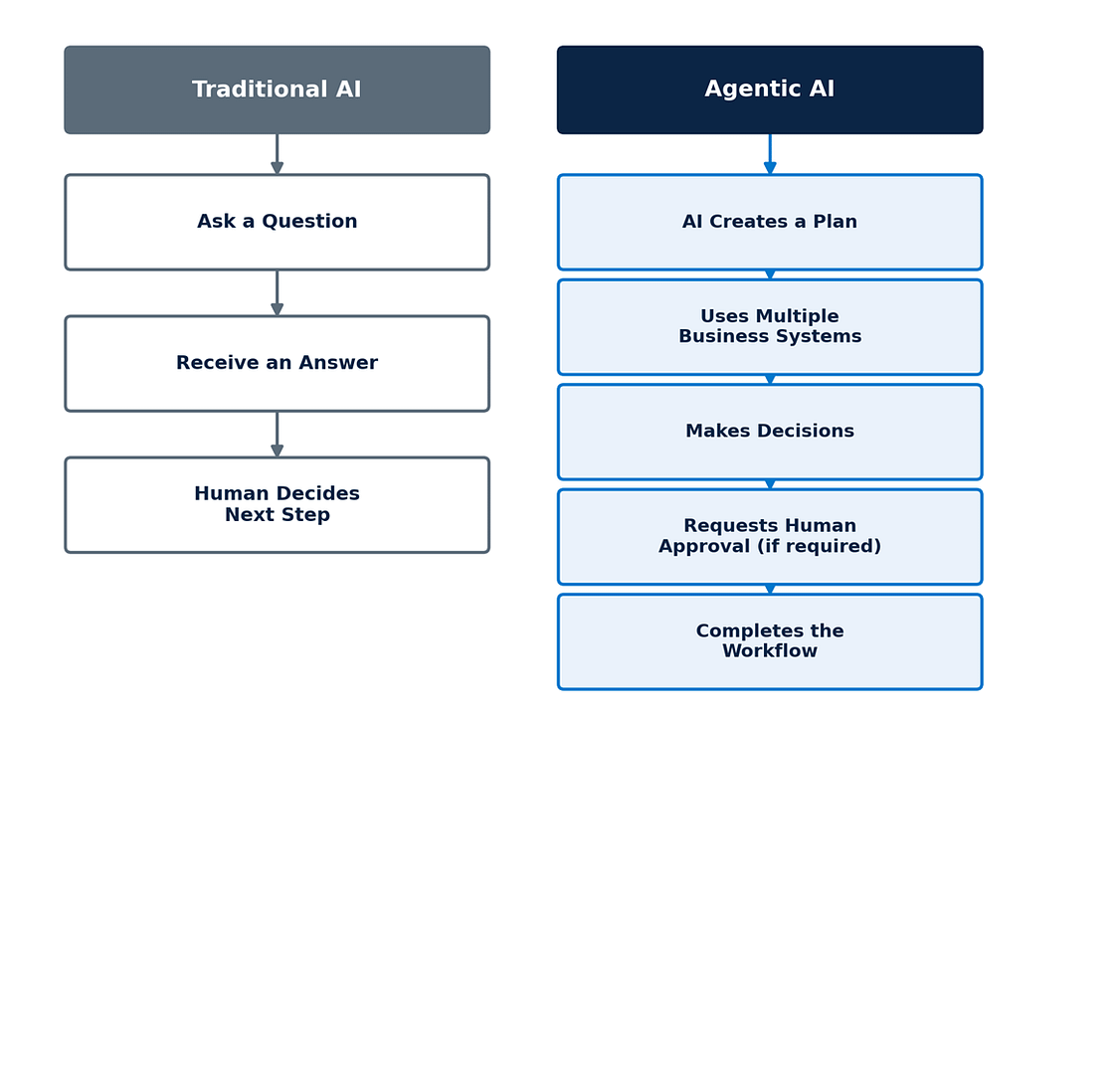
Figure 1: Traditional AI completes individual tasks. Agentic AI works towards an overall business objective.
Why Now?
Agentic AI didn’t appear overnight. Several technologies have matured at roughly the same time: large language models have become significantly better at reasoning; context windows have expanded, allowing AI to work across much larger volumes of information; modern models can now interact with software tools rather than simply generating text; and cloud platforms have made enterprise AI far easier to deploy securely. Businesses themselves have also become more comfortable experimenting with AI inside day to day operations.
Taken individually, each development matters. Together, they’ve created something entirely new. For the first time, organisations can build AI systems that don’t simply generate answers. They can execute work.
What Actually Makes an AI Agent?
One of the biggest misconceptions is that Agentic AI is just another name for ChatGPT. It isn’t. The language model is only one component, best thought of as the reasoning engine. Around it sits an entire architecture designed to help the AI behave more like a digital worker than a chatbot.
Most enterprise AI agents combine several capabilities:
- Reasoning: understanding objectives and making informed decisions
- Planning: breaking large pieces of work into smaller tasks
- Memory: remembering previous conversations, ongoing projects and user preferences
- Tool integration: interacting with business systems such as Outlook, SharePoint, Salesforce, SAP, ServiceNow, Jira or internal APIs
- Reflection: reviewing its own work before continuing
- Human approval: providing governance whenever an important decision needs oversight
On their own, none of these capabilities is particularly impressive. It’s the combination that changes what AI is capable of achieving.
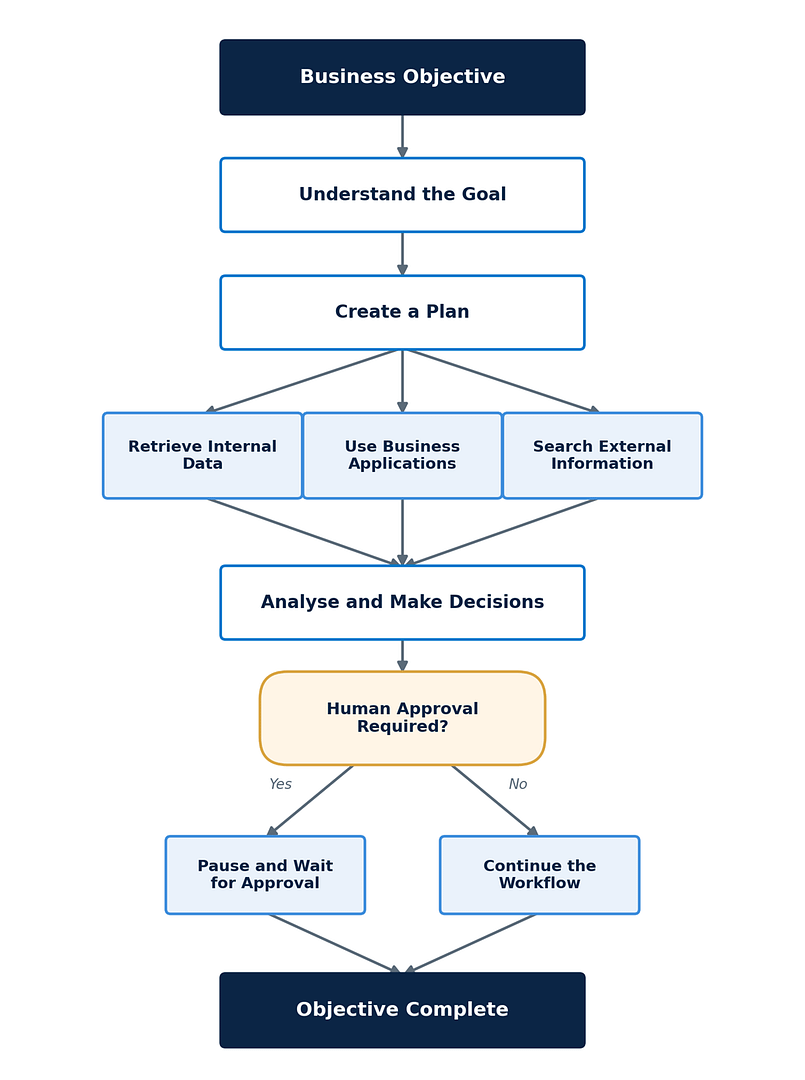
Figure 2: A simplified view of how an AI agent plans, reasons, interacts with business systems and completes a workflow.
The Shift That Many Organisations Haven’t Yet Recognised
Most businesses still think about AI one task at a time. Can it answer customer questions? Can it write reports? Can it summarise meetings? Can it produce code? Those are all useful applications, but they don’t fundamentally change how work flows through an organisation.
Agentic AI encourages a different question. Instead of asking which individual task should be automated, organisations should ask which entire business process could be redesigned. That’s a much bigger opportunity, because very few business processes consist of one isolated task.
Customer onboarding, insurance claims, mortgage approvals, employee recruitment, supplier management, project delivery and software development each involve dozens of activities spread across multiple departments, systems and people. Those workflows are increasingly becoming the natural home for Agentic AI.
Why Business Leaders Should Care
Every major technology shift changes something fundamental. The internet connected organisations. Cloud computing changed where applications run. Mobile technology changed where work happens. Generative AI changed how knowledge is created. I believe Agentic AI will change how work itself is organised.
That makes this more than another technology trend. It’s a business transformation opportunity. The organisations that embrace it successfully won’t simply become more productive; they’ll redesign processes that may not have changed for decades, creating faster customer journeys, simpler operations and new ways of delivering value.
That, more than the technology itself, is why Agentic AI deserves the attention it’s now receiving in boardrooms around the world.
From Intelligent Assistants to Intelligent Workflows
The first time most organisations see Agentic AI in action, they’re impressed by the technology. The second time, they start thinking about productivity. By the third conversation, the discussion has usually changed completely: instead of asking what AI can do, they begin asking which parts of the business no longer need to be performed the same way.
That is the point where Agentic AI becomes genuinely transformational. The biggest opportunity isn’t making individual employees 20% more productive. It’s redesigning entire business processes from beginning to end.
Stop Thinking About Individual Tasks
Many AI projects begin with questions like: can AI summarise meetings, answer customer emails, write proposals, or produce code? Those are all worthwhile use cases, but each only addresses one activity within a much larger workflow.
Take customer onboarding as an example. In many organisations it involves sales, finance, legal, operations, IT and customer success. Information moves from one department to another, documents are emailed around the business, and people spend time chasing approvals and manually updating multiple systems. None of that is particularly complex. It’s simply fragmented, spread across too many people and too many systems.
Now imagine redesigning that same process using Agentic AI. Once a customer signs a contract, an AI agent could verify the information provided, request any missing documentation, initiate credit checks, generate contracts, create customer records, schedule implementation meetings, provision user accounts, notify internal teams and keep the customer informed throughout the journey. If something unexpected happens, the AI pauses and asks for human input; otherwise, it keeps moving the process forward.
This isn’t really automation, since businesses have been automating individual tasks for years. What’s different is orchestration: joining those tasks into one continuous flow that manages itself.
Customer Service Is an Obvious Starting Point
Customer service has become one of the earliest adopters of Agentic AI because the opportunity is so visible. Traditional chatbots tend to work well until the customer asks something unexpected, at which point the conversation usually ends with a familiar message: “I’m sorry, let me transfer you to one of our advisers.” The customer then repeats everything they’ve already explained.
Agentic AI approaches the problem differently. Imagine you’ve reported a damaged vehicle to your insurer. Instead of answering a few questions before handing you to a human, an AI agent could verify your identity, retrieve your policy details, assess whether the incident is covered, request photographs, analyse the images, arrange vehicle repairs, organise a courtesy car, update the claims system and keep you informed throughout the process. Only the more complex claims would need a human specialist.
The customer experiences one continuous journey instead of moving between departments, and the organisation reduces cost while improving the experience at the same time. That’s exactly the outcome most businesses are chasing.
Sales Teams Don’t Need More Software
One of the biggest misconceptions about AI is that sales teams need another application. In reality, most sales professionals already have too many: CRM, LinkedIn, email, calendar, proposal software, marketing automation, customer data platforms. The problem isn’t a lack of technology. It’s the amount of time spent moving between all of it.
Agentic AI has the potential to remove much of that friction. An AI agent can research a prospective customer before a meeting, review their latest financial results, analyse industry news, identify decision makers, prepare briefing notes, draft personalised proposals, update the CRM after meetings and schedule follow up actions automatically.
Sales professionals stay focused on what humans do exceptionally well: building trust, understanding people, negotiating and closing business. The administration increasingly disappears into the background.
Software Development Is Changing Faster Than Most People Realise
Software engineering has always evolved alongside new tools. IDEs improved coding, version control improved collaboration, cloud computing transformed deployment, and generative AI accelerated development. Agentic AI is beginning to change the development lifecycle itself.
Rather than just helping developers write code, AI agents can increasingly manage much of the surrounding process. Imagine a new feature request: an agent reviews the requirement, identifies the affected services, suggests an implementation approach, generates code, produces unit tests, runs security checks, creates documentation, raises a pull request and monitors production after deployment.
The developer remains responsible for technical decisions and quality, but the repetitive work becomes significantly smaller. That’s why many technology leaders believe software engineering will be one of the industries most heavily influenced by Agentic AI over the next five years.
Healthcare Presents Enormous Potential
Healthcare professionals spend years developing highly specialised skills, yet much of their time is consumed by administration: updating records, preparing discharge summaries, reviewing previous consultations, scheduling follow up appointments and managing referrals.
Agentic AI has the potential to remove much of this administrative burden. A clinician should spend more time treating patients, not completing paperwork. The same principle applies across many professions built on deep expertise, including law, accountancy, architecture, consulting and financial advice. Highly skilled professionals should spend their time applying that expertise rather than moving information between systems.
The Rise of Agent Teams
One of the most fascinating developments is the move towards teams of AI agents rather than one extremely capable agent. This mirrors how organisations already operate: businesses don’t expect one individual to perform every role, they assemble teams across marketing, finance, legal, operations and technology, each contributing something different.
Modern Agentic AI platforms are beginning to follow the same principle. A research agent gathers information, a planning agent decides how work should be approached, an analysis agent evaluates the data, a writing agent prepares reports, a governance agent checks compliance, and a quality assurance agent validates the output before anything reaches the customer.
Each specialist performs one role exceptionally well. Collectively, they achieve outcomes that would be difficult for one agent working alone.
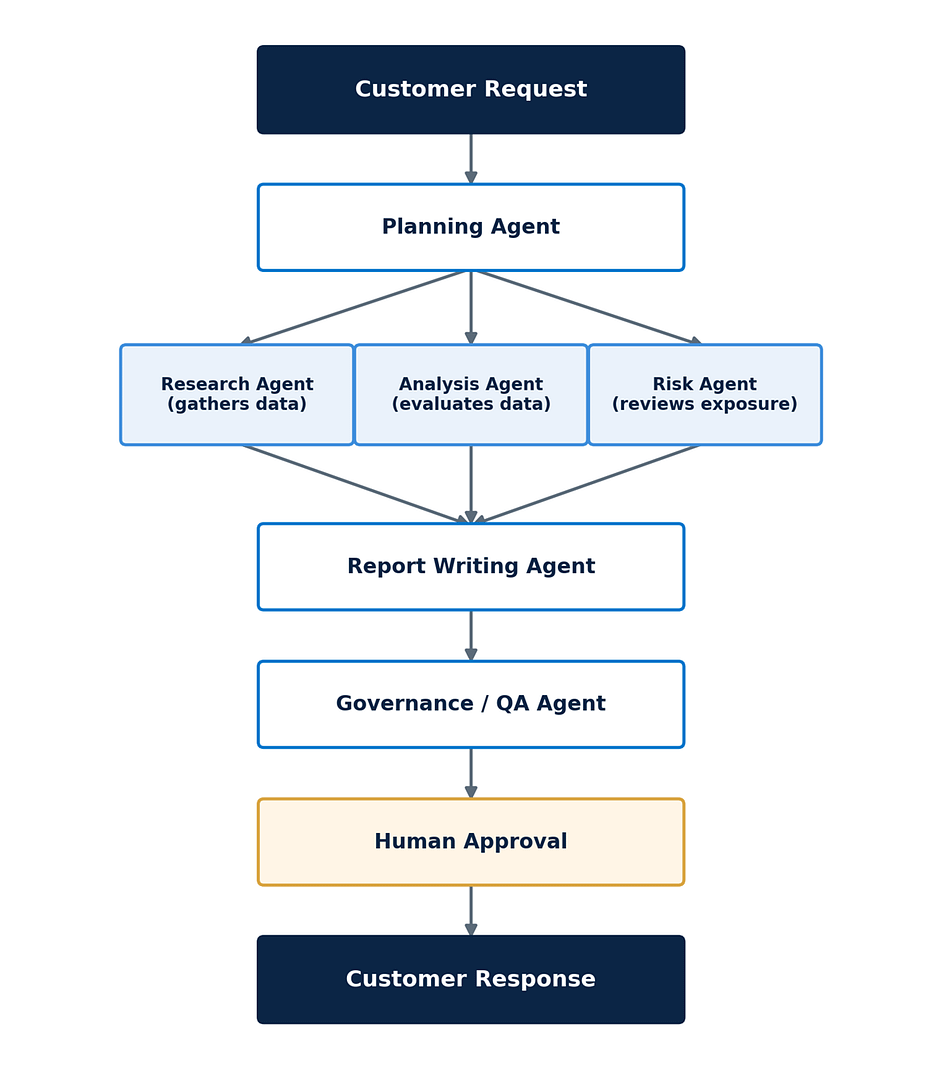
Figure 3: Specialist AI agents collaborate in much the same way as human teams.
Why Orchestration Is Becoming So Important
When people first discover Agentic AI, they often focus on the intelligence of the individual agent. In my view, that’s only part of the story. The bigger challenge is coordination.
Think about an orchestra. Each musician may be world class, but without a conductor the performance quickly falls apart. Agentic AI works in much the same way. Individual agents may each perform their own role brilliantly, but something still needs to coordinate the workflow: which agent starts first, what information passes to the next one, what happens if a task fails, when a person should get involved, and how priorities should change as circumstances change.
This orchestration layer is becoming one of the most valuable capabilities within modern Agentic AI platforms, and one of the reasons the market has become so diverse. Some vendors specialise in AI reasoning, others in workflow orchestration, and others in governance or enterprise integration. Understanding those differences is becoming increasingly important.
One Lesson I’ve Already Learned
One pattern has emerged from almost every organisation I’ve spoken to: the technology is rarely the biggest challenge. The business process usually is.
Many organisations have workflows that evolved over ten or fifteen years. Different departments introduced different systems, processes were adapted as regulations changed, new approval steps were added, and manual workarounds became permanent.
Before introducing AI, it’s worth asking a simple question: “If we were designing this process today, would we build it the same way?” Very often, the answer is no. That’s why successful Agentic AI projects rarely begin with technology. They begin with process redesign.
The Human Role Isn’t Disappearing
Every discussion about AI eventually arrives at the same question: “Will it replace people?” I don’t think that’s the most useful question. A better one is: “Which activities genuinely require human judgement?”
Empathy, negotiation, leadership, creativity, making ethical decisions and solving complex problems remain fundamentally human strengths. The repetitive coordination of routine work is where AI increasingly excels.
The future I see isn’t one where organisations replace people with AI. It’s one where people manage increasingly capable digital colleagues. That changes the nature of work. It doesn’t remove the need for people.
Choosing the Right Agentic AI Platform
If you’ve spent any time researching Agentic AI, you’ve probably reached one overwhelming conclusion: there are an awful lot of platforms. Every vendor claims to offer autonomous AI, every product claims to build intelligent agents, and every demonstration looks revolutionary. It can be difficult to separate genuine capability from clever marketing.
One common misconception is that all Agentic AI platforms compete directly with one another. They don’t. In fact, many complement each other: some provide the underlying intelligence, some specialise in building agents, others orchestrate complex workflows, and others provide enterprise governance. Understanding where each platform sits within the ecosystem matters far more than comparing feature lists.
Start With the Right Question
One mistake I see organisations make is asking “Which is the best Agentic AI platform?” There isn’t one. A better question is “What problem are we trying to solve?”
If your organisation already runs almost entirely on Microsoft 365, your answer is likely to be very different from one built around AWS or Google Cloud. Likewise, if your objective is automating customer onboarding, you’ll probably choose different tools than if you’re building software products built around AI. Technology should always follow the business problem, not the other way round.
Foundation AI Models
These platforms provide the intelligence behind many Agentic AI solutions. Think of them as the reasoning engines behind everything else. On their own they aren’t complete enterprise solutions, but they provide the capabilities that many other platforms build upon.
OpenAI
OpenAI remains one of the most influential organisations in the AI industry. While ChatGPT gets most of the attention, the real enterprise value comes from OpenAI’s APIs and reasoning models. Many commercial AI platforms use OpenAI models behind the scenes because of their strong reasoning, coding capabilities and tool integration. If you’re building bespoke AI applications, OpenAI is often one of the first places developers start.
Best suited for: custom AI applications, intelligent assistants, software development, enterprise AI solutions and advanced reasoning.
Anthropic Claude
Claude has become particularly popular within enterprises working with large amounts of documentation: legal firms, financial institutions, consultancies, government departments and research organisations all rely on it heavily. Its ability to understand long documents while maintaining context makes it exceptionally strong for knowledge work, and many developers also consider it one of the strongest coding assistants currently available.
Best suited for: research, legal, financial services, policy analysis and software engineering.
Google Gemini
Gemini is Google’s answer to enterprise AI. It integrates naturally with Google Workspace while also benefiting from Google’s expertise in search, data and cloud computing. For organisations already invested in Google’s ecosystem, Gemini often provides the most seamless experience.
Best suited for: Google Workspace, enterprise productivity, knowledge management, enterprise search and data analysis.
Enterprise AI Platforms
These platforms provide much more than AI models. They help organisations build, deploy, govern and manage AI solutions at enterprise scale.
Microsoft Copilot Studio
Copilot Studio is one of Microsoft’s most significant investments in enterprise AI. Rather than requiring organisations to build everything from scratch, it lets businesses create AI agents that interact naturally with Outlook, Teams, SharePoint, Dynamics 365 and the wider Power Platform. Because these services are already familiar, Copilot Studio allows AI to become part of existing ways of working rather than introducing an entirely new ecosystem. One of its biggest strengths is accessibility. Business users with relatively little coding experience can create surprisingly capable AI agents.
Best suited for: Microsoft organisations, internal business processes, employee productivity, AI development that needs minimal coding, and Microsoft 365 automation.
Azure AI Foundry
Azure AI Foundry sits behind many enterprise AI programmes. Rather than focusing on one chatbot or one agent, it provides the engineering platform needed to build AI solutions that are genuinely ready for production, supporting multiple models, evaluation frameworks, observability, security, responsible AI and governance. For larger organisations deploying AI across multiple business units, it provides the foundation needed to manage AI safely at scale. Think of Copilot Studio as building individual AI workers, and Azure AI Foundry as building the organisation those workers operate within.
Best suited for: enterprise AI engineering, responsible AI, governance, production deployments and AI programmes that need to run at scale.
Amazon Bedrock
Amazon has taken a different approach. Rather than encouraging organisations to standardise on one model, Bedrock provides managed access to multiple foundation models through AWS. This gives businesses flexibility. Some tasks may work better with Claude, others with OpenAI or a different specialist model, and everything stays inside the AWS ecosystem.
Best suited for: AWS customers, access to multiple AI models, enterprise cloud deployments and secure enterprise environments.
Agent Development Frameworks
These platforms are aimed primarily at developers building sophisticated AI applications.
LangChain
LangChain was one of the first frameworks to become widely adopted. It provides the building blocks needed to connect language models with databases, APIs, documents and software tools. Many of today’s AI applications began life as LangChain projects, and although newer frameworks have emerged, it remains enormously influential because of its flexibility.
Best suited for: developers, custom AI applications, tool integration, RAG applications and rapid prototyping.
LangGraph
LangGraph extends many of LangChain’s concepts but introduces capabilities specifically designed for AI workflows that run over long periods, including memory, state management, branching logic and agent collaboration. These are exactly the capabilities complex enterprise workflows need. If LangChain provides the components, LangGraph provides the orchestration.
Best suited for: systems built from multiple agents, enterprise workflows, long running processes and AI orchestration.
CrewAI
CrewAI has become popular because its philosophy is immediately understandable: instead of building one highly intelligent AI, build a team of specialist agents. One researches, one plans, one analyses, one writes, one validates. Each agent has a clearly defined responsibility, and collectively they often produce higher quality results than one agent attempting every task. This mirrors how successful human teams already operate.
Best suited for: collaboration between multiple agents, research, planning and workflow automation.
AutoGen
Originally developed by Microsoft Research, AutoGen focuses on enabling multiple AI agents to collaborate autonomously. It’s particularly popular in research environments and software engineering, where agents need to exchange information, debate solutions and solve complex technical problems together.
Best suited for: research, software engineering, autonomous collaboration and experimental AI systems.
Workflow and Enterprise Orchestration Platforms
This is where the market becomes particularly interesting. These platforms aren’t simply building intelligent agents. They’re embedding AI directly into real business operations.
n8n
n8n started life as a workflow automation platform. Today it’s become one of the easiest ways to connect AI with existing business systems such as CRM, ERP, finance, marketing and customer support, without replacing any of them. AI simply becomes another component within the workflow. For organisations wanting quick results without major software development, n8n can be an excellent starting point.
Best suited for: workflow automation, business integration, development that needs little coding, and business processes enabled by AI.
aiXplain
aiXplain takes a broader architectural view. Rather than concentrating solely on AI agents, it provides a platform for orchestrating multiple AI services, foundation models, speech technologies, translation engines and specialist AI capabilities. Its marketplace lets organisations combine components from multiple providers into one coherent solution, which is particularly valuable for larger enterprises that don’t want to depend on a single AI vendor.
Many frameworks help developers build AI. aiXplain helps organisations build AI ecosystems. It’s solving an enterprise architecture challenge rather than simply a software development one.
Best suited for: enterprise AI orchestration, access to multiple AI models, AI marketplaces and enterprise integration.
Moxo
Moxo approaches AI from an operational perspective. Its focus isn’t building smarter AI. It’s building better business journeys. The platform combines AI with customer collaboration, approvals, document management, messaging and workflow orchestration, which makes it particularly attractive for organisations in regulated industries such as financial services, healthcare, insurance and legal, where governance, auditability and customer communication are critical.
Many Agentic AI platforms concentrate on intelligence. Moxo concentrates on execution, connecting AI, employees, customers and business processes into one governed workflow.
Best suited for: customer workflows, secure collaboration and governed processes in regulated industries.
Craft Agents
Craft represents one of the most interesting new arrivals in the Agentic AI landscape. Rather than adding AI to an existing productivity application, it’s been designed from the outset as a workspace built for agents from the ground up, which is a small distinction that turns out to matter a great deal.
Most AI platforms still assume humans sit at the centre of every interaction. Craft assumes AI agents are active participants in everyday work: multiple agents can collaborate simultaneously, maintain context over long periods, and interact with APIs, documents, MCP servers and enterprise systems while staying organised inside a workspace built around documents. The experience feels less like chatting with an AI and more like managing a team of digital colleagues working alongside you.
I find this an interesting direction because it challenges the assumption that AI always begins with a chat window. Perhaps future business applications will be built around teams of AI agents working quietly in the background, with people supervising outcomes rather than individual tasks. Craft gives an early glimpse of what that future might look like.
Best suited for: knowledge workers, collaboration across teams, workflows built around documents, and environments designed for one agent or many working together.
So Which Platform Should You Choose?
| Platform | Best for | Strength | Typical users |
| OpenAI | Custom AI applications | Excellent reasoning and APIs | Developers, enterprises |
| Claude | Document analysis | Long context and strong reasoning | Legal, research, financial services |
| Google Gemini | Google Workspace | Productivity and enterprise search | Google Cloud customers |
| Microsoft Copilot Studio | Microsoft 365 automation | AI agents with minimal coding | Business users |
| Azure AI Foundry | Enterprise AI platforms | Governance, deployment and observability | Enterprise IT |
| Amazon Bedrock | AWS environments | Access to multiple AI models | AWS organisations |
| LangChain | AI development | Flexible application framework | Developers |
| LangGraph | Orchestration across multiple agents | Stateful workflows | AI engineers |
| CrewAI | Specialist AI teams | Collaborative agents | Developers, researchers |
| AutoGen | Autonomous collaboration | Communication between agents | Technical teams |
| n8n | Workflow automation | Connects hundreds of business systems | SMEs and enterprises |
| aiXplain | Enterprise AI orchestration | Ecosystem spanning multiple AI models | Large enterprises |
| Moxo | Customer workflows | Secure collaboration and governed processes | Financial services, healthcare, legal |
| Craft Agents | Workspaces built for agents | Designed around AI colleagues rather than chatbots | Knowledge workers |
There isn’t a single winner, and there probably never will be.
If you’re heavily invested in Microsoft technologies, Copilot Studio and Azure AI Foundry provide a natural progression. If your organisation runs primarily on AWS, Amazon Bedrock is an obvious choice. If you’re building bespoke AI applications, LangGraph or CrewAI offer enormous flexibility. If your priority is workflow automation, platforms such as n8n or Moxo may deliver faster business value. If you’re orchestrating AI across an enterprise, aiXplain deserves serious consideration. And if you’re exploring what the next generation of software built for agents might look like, Craft is one of the most innovative platforms currently emerging.
Ultimately, technology is only one part of the equation. In my experience, organisations spend far too much time comparing platforms and far too little time redesigning the business processes those platforms are meant to improve. The platform matters. The workflow matters even more.
Where Agentic AI Goes Next
If the last few years have taught us anything, it’s that predicting the future of AI is a dangerous business. Progress has consistently exceeded expectations, and capabilities that seemed years away have often arrived within months. Agentic AI is likely to follow the same pattern.
Today’s AI agents are already capable of coordinating workflows, interacting with business systems and completing increasingly sophisticated tasks. Five years from now, we’ll probably look back and wonder why we ever thought these capabilities were remarkable.
The more interesting question isn’t how intelligent AI will become. It’s how organisations will adapt around it. Technology has always changed the tools we use; Agentic AI has the potential to change the structure of work itself.
The Organisations That Will Benefit Most
One assumption I hear regularly is that large organisations will automatically benefit most from Agentic AI. I’m not convinced that’s true.
Large organisations certainly have greater resources, but they also have greater complexity: legacy systems, multiple business units, regulatory obligations and lengthy approval processes. Smaller organisations often have an advantage. They can redesign workflows more quickly, experiment, fail fast, and implement change without navigating layers of governance committees and organisational politics.
The winners won’t necessarily be the organisations with the biggest AI budgets. They’ll be the organisations willing to rethink how work flows through the business. That mindset matters far more than any individual technology platform.
Governance Is About Enabling Innovation
Whenever governance is mentioned, people often assume it slows innovation. In my experience, the opposite is usually true. Organisations that establish sensible governance early tend to innovate more confidently, because everyone understands the boundaries: what data AI can access, which decisions require human approval, who is accountable, and how outputs are monitored.
Without that clarity, organisations become hesitant, projects stall and confidence erodes. Good governance doesn’t stop people using AI. It gives them the confidence to use it responsibly. As AI agents become more autonomous, governance will move from being a compliance exercise to becoming a strategic capability.
Security Will Become Even More Important
Unlike a chatbot, an AI agent rarely operates in isolation. It may access customer records, financial systems, email, document repositories, CRM platforms, knowledge bases, internal APIs and potentially dozens of other enterprise systems.
That creates enormous opportunity, but it also increases responsibility. Identity management, access based on role, encryption, monitoring, audit trails and data protection have always mattered. With Agentic AI, they become absolutely fundamental. An intelligent agent is only as trustworthy as the environment in which it operates.
Five Predictions for the Next Five Years
Nobody knows exactly where Agentic AI will take us, but here are five developments I think are highly likely.
1. Every knowledge worker will manage AI agents
Today we manage calendars, email and documents. Tomorrow we’ll also manage teams of AI agents, some specialising in research, others in administration, others in customer engagement. Managing AI agents may become as normal as managing your inbox.Business processes will become the new battleground
2. Business processes will become the new battleground
For years, organisations competed by implementing better software. Increasingly, they’ll compete by designing better workflows. Two companies may own exactly the same AI technology, but the one with the better business process will almost certainly outperform the other.
3. AI projects will become business transformation projects
Many organisations still treat AI as an IT initiative. That won’t last. Successful Agentic AI programmes require operations, HR, legal, finance, technology and business leadership to work together, shifting the conversation from technology implementation to organisational redesign.
4. Human judgement becomes even more valuable
As routine work becomes increasingly automated, uniquely human capabilities such as leadership, empathy, negotiation, creativity, strategic thinking and ethical judgement become more important, not less. The value of these skills is likely to increase rather than diminish.
5. Every organisation will eventually have an AI operating model
Just as organisations developed cloud strategies, cybersecurity strategies and data strategies, they’ll also develop AI operating models: how AI agents are created, who owns them, how they’re governed, how they’re monitored, and how they’re retired. These questions will become a normal part of enterprise architecture.
So Where Should Organisations Begin?
One piece of advice I consistently give organisations: don’t start with AI, start with the business problem. Look for processes that frustrate employees, that customers complain about, that involve multiple handoffs, or that depend on repetitive administration. Those are often the best candidates.
Choose one. Redesign it. Measure the results. Learn from the experience. Then move to the next process. Organisations don’t become enabled by AI overnight. They improve one workflow at a time.
One Final Observation
I’ve noticed something interesting over the past year. The organisations making the fastest progress with AI aren’t necessarily the ones talking most about AI. They’re talking about customer experience, operational efficiency, employee productivity, service quality and business growth. AI simply becomes another capability helping them achieve those objectives.
Perhaps that’s where the conversation should always have started. Technology is rarely the destination. It’s simply the vehicle.
Final Thoughts
Every decade seems to produce a technology that fundamentally changes the way organisations operate. The internet connected businesses to the world. Cloud computing changed where applications run. Mobile technology changed where work happens. Generative AI changed how knowledge is created.
I believe Agentic AI has the potential to change how work itself is performed. Not because AI suddenly becomes more intelligent than people, but because organisations begin redesigning processes around genuine collaboration between people and machines. That’s a very different proposition.
The businesses that gain the greatest advantage won’t simply deploy AI. They’ll rethink how work flows across the organisation, remove unnecessary complexity, automate repetitive coordination, and empower employees to spend more time applying judgement, creativity and expertise. In many respects, that’s what technology has always promised. Agentic AI may be the first generation capable of delivering it at scale.
A Conversation Worth Having
Every organisation is at a different stage of its AI journey. Some are still exploring generative AI. Others are beginning to experiment with autonomous agents. A few are already redesigning complete business processes around Agentic AI.
Whichever stage you’re at, this is an exciting time to be thinking differently about how work gets done. If your organisation is exploring Agentic AI, whether that’s improving customer journeys, automating operational processes, deploying AI responsibly, or establishing the right governance framework, I’d be delighted to exchange ideas. Feel free to connect or send me a direct message.
The best AI conversations rarely start with technology. They start with a business challenge that’s waiting to be solved.
#AgenticAI #ArtificialIntelligence #EnterpriseAI #AIAgents #DigitalTransformation #BusinessTransformation #Automation #IntelligentAutomation #FutureOfWork #AILeadership #ResponsibleAI #AIGovernance #Innovation #TechnologyLeadership #BusinessStrategy #ProductManagement #DigitalInnovation #MicrosoftCopilot #AzureAI #OpenAI #ClaudeAI #GoogleGemini #AWS #LangChain #LangGraph #CrewAI #AutoGen #n8n #aiXplain #CraftAgents #Moxo